
Mathematics becomes easier when we understand its basic rules. Calculus is one important part of mathematics. It helps us study how things change. One useful topic in calculus is the derivative of arctan. Students often learn this topic when they study inverse trigonometric functions.
The derivative of arctan may look difficult at first. However, its main formula is very simple. Once you understand the formula, you can solve many different questions. You can also use it in algebra, physics, engineering, and other subjects.
In this guide, we will explain the derivative of arctan in simple English. We will look at its formula, meaning, proof, examples, and common mistakes. Moreover, we will explain how to use the chain rule with arctan. Each example will help you understand the topic step by step.
What Is Arctan?
Arctan is short for inverse tangent. It is also written as tan⁻¹(x) or arctan(x). It helps us find an angle when we know the value of its tangent.
For example, imagine that the tangent of an angle is 1. We can use arctan to find the angle. The answer is 45 degrees or π/4 radians. Therefore, arctan works backward from the tangent function.
Arctan belongs to a group called inverse trigonometric functions. Other members of this group include arcsin and arccos. These functions help us find angles from known trigonometric values.
Here are some important facts about arctan:
- Arctan is the inverse of tangent.
- We can write it as arctan(x).
- We can also write it as tan⁻¹(x).
- Its output represents an angle.
- Its derivative is defined for every real number.
- Its principal output range is between -π/2 and π/2.
It is important to understand that tan⁻¹(x) does not mean 1/tan(x). Instead, it means the inverse tangent function. This difference matters when solving calculus problems.
What Is the Derivative of Arctan?
The derivative of arctan tells us how quickly the arctan function changes when its input changes. In simple words, it measures the slope of the curve at a particular point.
The function has a smooth curve. Its slope changes as x changes. However, the derivative always gives a positive value because the arctan function increases from left to right.
The standard formula is easy to remember. It is one of the most important formulas for inverse trigonometric functions.
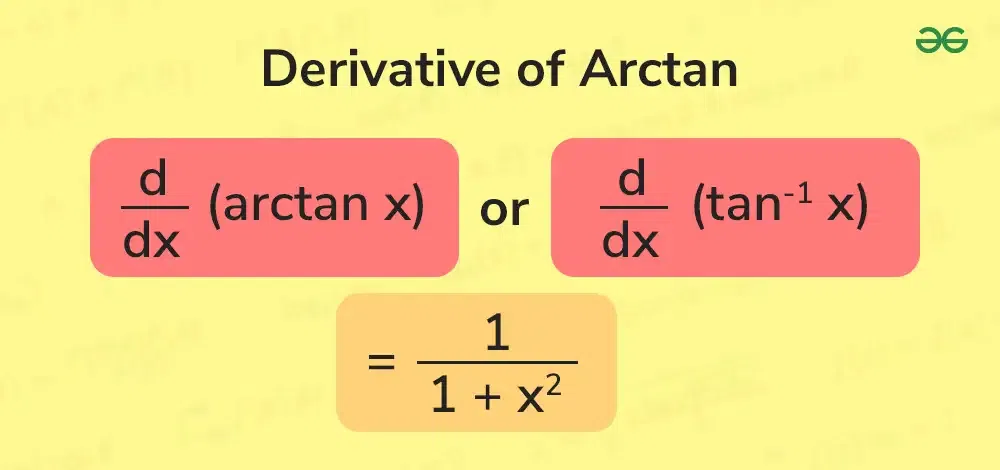
The derivative of arctan x is:
[
\boxed{\frac{d}{dx}\arctan(x)=\frac{1}{1+x^2}}
]
You can also write the same formula in another way:
[
\boxed{\frac{d}{dx}\tan^{-1}(x)=\frac{1}{1+x^2}}
]
Both expressions mean exactly the same thing. Therefore, you can use either form in your calculus problems.
Let’s understand the parts of this formula:
- d/dx: This symbol means that we are finding a derivative with respect to x.
- Arctan(x): This is the inverse tangent function.
- 1: This number stays in the numerator.
- x²: This means x multiplied by itself.
- 1 + x²: This complete expression forms the denominator.
For example, if x equals 2, we put 2 into the formula. We get 1 divided by 1 plus 4. Therefore, the derivative equals 1/5.
Why Is the Derivative of Arctan Important?
The derivative of arctan is important because it helps us solve many calculus problems. It appears in questions about slopes, rates of change, inverse functions, and integration.
Students also use this formula when they study more advanced mathematics. For example, engineers use calculus to study changing angles and physical systems. Scientists also use derivatives to understand mathematical models.
Furthermore, this formula helps us understand the relationship between tangent and inverse tangent. It shows how the inverse function changes when its input becomes larger or smaller.
Here are some common uses:
- Calculus: It helps solve differentiation problems.
- Physics: It helps study changing angles and motion.
- Engineering: It appears in mathematical models and technical calculations.
- Algebra: It helps simplify expressions that contain inverse tangent.
- Integration: It helps us recognize important integral formulas.
- Trigonometry: It connects tangent with inverse tangent.
Therefore, learning this formula gives you a useful foundation for more advanced topics.
Proof of the Derivative of Arctan
Now, let’s understand why the derivative of arctan has this formula. We can prove it by using implicit differentiation.
Start with this equation:
[
y=\arctan(x)
]
Since arctan is the inverse of tangent, we can rewrite it as:
[
\tan(y)=x
]
Now, differentiate both sides with respect to x.
[
\sec^2(y)\frac{dy}{dx}=1
]
We use the chain rule here because y depends on x. Next, we want to make dy/dx the subject.
Divide both sides by sec²(y):
[
\frac{dy}{dx}=\frac{1}{\sec^2(y)}
]
Now, remember this trigonometric identity:
[
\sec^2(y)=1+\tan^2(y)
]
We can use this identity in our equation.
[
\frac{dy}{dx}=\frac{1}{1+\tan^2(y)}
]
But we already know that tan(y) equals x. So, we replace tan(y) with x.
[
\frac{dy}{dx}=\frac{1}{1+x^2}
]
Finally, we get the answer:
[
\boxed{\frac{d}{dx}\arctan(x)=\frac{1}{1+x^2}}
]
This proves the derivative of arctan formula. Notice that we only needed the inverse relationship, the chain rule, and one trigonometric identity.
Step-by-Step Examples of the Derivative of Arctan
The best way to learn a calculus formula is to practice it. Let’s solve some simple examples. These examples will show how the derivative of arctan works with different values and expressions.
Example 1: Find the Derivative of Arctan(x)
Question:
Find the derivative of:
[
y=\arctan(x)
]
Solution:
First, write the standard derivative formula:
[
\frac{d}{dx}\arctan(x)=\frac{1}{1+x^2}
]
Now, replace the function with its derivative.
[
y’=\frac{1}{1+x^2}
]
Final answer:
[
\boxed{y’=\frac{1}{1+x^2}}
]
This is the simplest example. You only need to remember the main formula.
Example 2: Find the Derivative of Arctan(2x)
Question:
Find the derivative of:
[
y=\arctan(2x)
]
Solution:
This example contains 2x inside the arctan function. Therefore, we need the chain rule.
The chain rule says that we first differentiate the outside function. Then, we multiply it by the derivative of the inside function.
[
y’=\frac{1}{1+(2x)^2}\times 2
]
Now, simplify the square:
[
y’=\frac{2}{1+4x^2}
]
Final answer:
[
\boxed{y’=\frac{2}{1+4x^2}}
]
Remember to multiply by 2. Many students forget this step when they use the chain rule.
Example 3: Find the Derivative of Arctan(3x)
Question:
Find the derivative of:
[
y=\arctan(3x)
]
Solution:
First, identify the inside function. Here, the inside function is 3x.
Its derivative is 3. Now, apply the chain rule.
[
y’=\frac{1}{1+(3x)^2}\times 3
]
Simplify the expression:
[
y’=\frac{3}{1+9x^2}
]
Final answer:
[
\boxed{y’=\frac{3}{1+9x^2}}
]
This example follows the same steps as the previous one. Only the number inside the arctan function has changed.
Example 4: Find the Derivative of Arctan(x²)
Question:
Find the derivative of:
[
y=\arctan(x^2)
]
Solution:
The inside function is x². Its derivative is 2x.
Now, apply the derivative of arctan formula.
[
y’=\frac{1}{1+(x^2)^2}\times 2x
]
Simplify the powers:
[
y’=\frac{2x}{1+x^4}
]
Final answer:
[
\boxed{y’=\frac{2x}{1+x^4}}
]
The important step is to remember that the square of x² becomes x⁴.
Example 5: Find the Derivative of Arctan(5x + 1)
Question:
Find the derivative of:
[
y=\arctan(5x+1)
]
Solution:
First, find the derivative of the inside expression.
[
\frac{d}{dx}(5x+1)=5
]
Next, apply the chain rule.
[
y’=\frac{5}{1+(5x+1)^2}
]
Final answer:
[
\boxed{y’=\frac{5}{1+(5x+1)^2}}
]
You can leave the answer in this form. Expanding the square is not necessary unless the question asks you to simplify it.
The Chain Rule for the Derivative of Arctan
The chain rule is one of the most useful rules in calculus. We use it when a function contains another function inside it.
For example, consider arctan(4x). The outside function is arctan. The inside function is 4x. We must differentiate both parts correctly.
The general chain rule formula for the derivative of arctan is:
[
\boxed{\frac{d}{dx}\arctan(u)=\frac{u’}{1+u^2}}
]
Here, u represents the inside function. Meanwhile, u’ represents its derivative with respect to x.
Let’s look at some common examples:
| Function | Derivative |
| arctan(2x) | 2/(1 + 4x²) |
| arctan(4x) | 4/(1 + 16x²) |
| arctan(x³) | 3x²/(1 + x⁶) |
| arctan(2x + 3) | 2/[1 + (2x + 3)²] |
| arctan(√x) | 1/[2√x(1 + x)] |
The main idea is simple. Differentiate the inside expression and place its derivative in the numerator. Then, place one plus the square of the inside expression in the denominator.
However, do not forget to use parentheses. They help you keep the correct expression together.
Derivative of Arctan With Respect to Time
Sometimes, we need to find the derivative of arctan with respect to time instead of x. This situation often appears in physics and other applied subjects.
Suppose we have:
[
y=\arctan(t)
]
We want to find the derivative with respect to t. The formula becomes:
[
\frac{dy}{dt}=\frac{1}{1+t^2}
]
Now, imagine that the inside function is more complicated.
[
y=\arctan(3t)
]
We use the chain rule again.
[
\frac{dy}{dt}=\frac{3}{1+9t^2}
]
The same rule works because we only change the variable. We can use x, t, or another variable.
Therefore, always check which variable the question asks you to differentiate.
Derivative of Arctan of a Fraction
Some questions contain fractions inside the arctan function. These questions may look harder. However, the same chain rule still works.
Consider this example:
[
y=\arctan\left(\frac{x}{2}\right)
]
First, differentiate the inside expression.
[
u=\frac{x}{2}
]
[
u’=\frac{1}{2}
]
Now, apply the main formula.
[
y’=\frac{\frac12}{1+\frac{x^2}{4}}
]
Multiply the numerator and denominator by 4.
[
\boxed{y’=\frac{2}{x^2+4}}
]
This method works for many fractions. First, find the derivative of the inside function. Then, use the main arctan formula.
Derivative of Arctan Squared
Another common question contains the square of an arctan function. It is important to understand the difference between arctan(x²) and [arctan(x)]².
These two expressions are not the same.
Consider:
[
y=[\arctan(x)]^2
]
Here, the complete arctan function has a square outside it. Therefore, we use the power rule and the chain rule.
First, differentiate the outside square:
[
y’=2\arctan(x)\times\frac{1}{1+x^2}
]
Now, write the final answer:
[
\boxed{y’=\frac{2\arctan(x)}{1+x^2}}
]
This example teaches an important lesson. Always check where the power appears before choosing a derivative rule.
Derivative of Arctan at Different Values
We can also use the derivative formula to calculate slopes at different points. This helps us understand how the function changes.
Remember the formula:
[
f'(x)=\frac{1}{1+x^2}
]
Let’s calculate some values.
When x = 0:
[
f'(0)=\frac{1}{1+0^2}=1
]
The slope equals 1.
When x = 1:
[
f'(1)=\frac{1}{1+1^2}=\frac12
]
The slope equals 0.5.
When x = 2:
[
f'(2)=\frac{1}{1+2^2}=\frac15
]
The slope equals 0.2.
When x = 3:
[
f'(3)=\frac{1}{1+3^2}=\frac{1}{10}
]
The slope equals 0.1.
Notice the pattern. As x becomes larger in absolute value, the derivative becomes smaller. This means the arctan curve becomes flatter as we move away from zero.
Graph of the Arctan Function and Its Derivative
A graph can make calculus easier to understand. The arctan function has an increasing S-shaped curve. It starts near -π/2 and slowly moves toward π/2.
The curve passes through the point (0, 0). At this point, its slope equals 1. As we move toward the left or right, the curve becomes flatter.
The derivative graph looks different. It follows the formula 1/(1 + x²). Its highest value occurs at x = 0. It also stays above the horizontal axis.
Here are some important graph features:
- The arctan function increases for every real x.
- It passes through the origin.
- It approaches -π/2 on the left.
- It approaches π/2 on the right.
- Its derivative reaches its maximum value at zero.
- Its derivative approaches zero as x moves toward positive or negative infinity.
These features help us understand the relationship between a function and its derivative.
Common Mistakes When Finding the Derivative of Arctan
Students sometimes make small mistakes when solving inverse trigonometric questions. These mistakes can change the final answer. Fortunately, you can avoid them by following a few simple rules.
Confusing arctan with reciprocal tangent
Arctan(x) means inverse tangent. It does not mean 1/tan(x). These expressions have different meanings and different derivatives.
Forgetting the chain rule
When you differentiate arctan(5x), you must multiply by 5. Otherwise, your answer will be incomplete.
Making mistakes with powers
If the inside function is x³, its square becomes x⁶. Always check your exponents carefully.
Forgetting parentheses
For arctan(2x + 1), the entire expression must appear inside the square in the denominator.
Using the wrong formula
Do not confuse the derivative of arctan with the derivatives of arcsin or arccos. Each inverse trigonometric function has its own formula.
6. Ignoring the inside derivative
The chain rule applies even when the inside expression looks simple. Always check whether you need to multiply by an additional derivative.
Tips for Learning the Derivative of Arctan
You do not need to memorize hundreds of examples. Instead, learn the main formula and understand how it works.
First, write the formula several times. This will help you remember it. Next, solve easy questions before moving toward more difficult ones.
Also, practice questions with different expressions. Try examples with numbers, powers, fractions, and brackets. This will help you understand when to use the chain rule.
Here are some useful study tips:
- Learn the main formula by heart.
- Understand why the formula works.
- Practice at least five questions each day.
- Check your answers carefully.
- Remember to use the chain rule.
- Keep your working steps organized.
- Review mistakes and solve them again.
Most importantly, do not rush. Calculus becomes easier when you understand each step instead of simply memorizing answers.
Difference Between Arctan and Other Inverse Trigonometric Functions
Arctan is one of three common inverse trigonometric functions. The other two are arcsin and arccos.
Each function has a different derivative. Therefore, it is important to learn their formulas separately.
| Function | Derivative |
| arcsin(x) | 1/√(1 – x²) |
| arccos(x) | -1/√(1 – x²) |
| arctan(x) | 1/(1 + x²) |
The derivative of arcsin contains a square root. The derivative of arccos also contains a square root, but it has a negative sign.
On the other hand, the derivative of arctan has 1 + x² in the denominator. This makes its formula easy to recognize.
All three functions help us work with angles. However, they solve different types of trigonometric problems.
How the Derivative of Arctan Connects to Integration
Differentiation and integration are closely related. Differentiation helps us find rates of change. Integration can help us find the original function when we know its derivative.
The derivative of arctan gives us another useful result in integration.
For example:
[
\int\frac{1}{1+x^2},dx
]
We know that the derivative of arctan(x) equals 1/(1 + x²). Therefore, we can write:
[
\boxed{\int\frac{1}{1+x^2},dx=\arctan(x)+C}
]
Here, C represents the constant of integration.
This formula appears in many calculus exercises. It is especially useful when solving integrals that contain a quadratic expression in the denominator.
For example:
[
\int\frac{2}{1+4x^2},dx
]
The answer is:
[
\boxed{\arctan(2x)+C}
]
Therefore, learning the derivative of arctan also helps you understand important integration rules.
Practice Questions About the Derivative of Arctan
Practice is one of the best ways to improve your calculus skills. Try these questions before looking at the answers.
Question 1:
Find the derivative of:
[
y=\arctan(4x)
]
Answer:
[
\boxed{\frac{4}{1+16x^2}}
]
Question 2:
Find the derivative of:
[
y=\arctan(x^3)
]
Answer:
[
\boxed{\frac{3x^2}{1+x^6}}
]
Question 3:
Find the derivative of:
[
y=\arctan(2x+5)
]
Answer:
[
\boxed{\frac{2}{1+(2x+5)^2}}
]
Question 4:
Find the derivative of:
[
y=[\arctan(x)]^3
]
Answer:
[
\boxed{\frac{3[\arctan(x)]^2}{1+x^2}}
Question 5:
Find the derivative of:
[
y=\arctan(7x)
]
Answer:
[
\boxed{\frac{7}{1+49x^2}}
]
Try solving each question on paper. Then, compare your working with the answers. This habit can help you become more confident in calculus.
FAQs
1. What Is the Derivative of Arctan(x)?
The derivative of arctan(x) is 1/(1 + x²). It is the standard formula for differentiating the inverse tangent function.
2. Is Arctan the Same as Tan Inverse?
Yes. Arctan(x) and tan⁻¹(x) represent the same inverse tangent function. However, tan⁻¹(x) does not mean the reciprocal of tangent.
3. What Rule Do We Use for Arctan(2x)?
We use the chain rule. First, differentiate the outside arctan function. Then, multiply by the derivative of the inside expression.
4. Can the Derivative of Arctan Be Negative?
No. For every real value of x, 1/(1 + x²) is positive. Therefore, the derivative of arctan(x) is always positive.
5. Is the Derivative of Arctan Defined Everywhere?
Yes. The denominator 1 + x² is always greater than zero for real x. Therefore, the derivative exists for every real number.
Conclusion
The derivative of arctan is an important formula in calculus. Its main rule is simple: the derivative of arctan(x) equals 1/(1 + x²). Once you understand this formula, you can solve many different differentiation problems.
We also learned how to use the chain rule with more complicated expressions. Furthermore, we explored the proof, graph, examples, and connection between differentiation and integration.
The best way to improve is through regular practice. Start with simple questions and slowly move toward harder ones. Remember the main formula, check your powers, and never forget the chain rule.
With these steps, the derivative of arctan becomes much easier to understand and use.
